FIA Cross Car
Explore official-source information about the FIA Cross Car in iRacing.
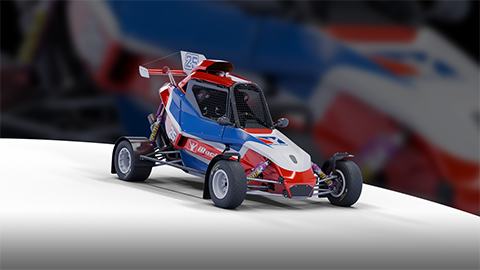
Image © iRacing.com Motorsport Simulations
Quick reference
- Chassis Type
- SLA, Coilover Shocks
- Power Unit
- Yamaha MT-09 890 cc 3-CylinderYamaha MT-09 54 cid 3-Cylinder
- Length
- 2,550 mm100 in
- Width
- 2,080 mm82 in
- Displacement
- 0.89 L54 cid
- Torque
- 93 Nm68.6 lb-ft
- RPM Limit
- 12,165 RPM
- Power
- 89 kW120 bhp
- Wheelbase
- 2,000 mm79 in
- Dry Weight
- 340 kg750 lb
- Wet Weight with Driver
- 435 kg959 lb
The FIA Cross Car combines a 120 bhp Yamaha three-cylinder engine with a 340 kg dry chassis. Its setup revolves around mechanical grip, suspension travel over bumps and jumps, and the balance between cornering grip and braking or acceleration.
Braking characteristics
Braking grip is linked to wheel alignment as well as the pedal. The manual warns that adding negative camber increases cornering capability but reduces longitudinal grip under braking; excessive camber can therefore bring frequent lock-ups. At the rear, excessive negative camber also reduces forward traction. Do not treat a cornering-grip gain as a free improvement in every phase of the lap.
Corner entry also depends on matching engine and rear-wheel speed during downshifts. An early downshift or an insufficient throttle blip can cause rear-wheel hop and a spin. Separate that transmission-induced instability from a brake-balance problem before changing the setup.
Brake controls and adjustments
Brake Pressure Bias sets the share of braking force sent to the front axle. Above 50%, the front brake circuit receives more pressure than the rear. Moving the balance forward can improve braking stability, but it also increases the tendency to lock the front tyres. Tune this control to the track conditions and your preference rather than treating 50% as a recommended setup value.
Dashboard and driver controls
The FIA Cross Car uses an AIM MXm digital dash display with two pages and built-in shift lights. Page 1 displays a bar-type tachometer with numerical RPM in the upper left, current throttle pedal position (GAS %) in the upper right, current gear (GEAR), coolant temperature (WTS F/C) in the lower left, and session best lap time (Best) in the lower right. Page 2 shows engine cooling fluid temperature (WTS F/C) in the upper left, RPM in the upper right, best lap time (Best) in the lower left, and throttle pedal position (GAS %) in the lower right. Five LEDs above the display illuminate sequentially with increasing RPM, recommending an upshift when all five are lit. The dash backlight color (SCREEN COLOR) can be changed via the F8 black box or in the garage, without affecting vehicle performance.
Tyres and operating conditions
Cold Pressure, or starting pressure, is the tire air pressure when the car loads. Lower pressures increase grip but also rolling drag and temperature. Higher pressures offer responsiveness and less drag but may reduce grip. Hot Pressure, displayed after a track stint, indicates how tires are loaded; greater pressure buildup suggests more work. Tire carcass temperatures (Last Temperatures) reveal workload, with inner/outer differences aiding alignment tuning and center-to-outer comparisons helping with pressure. Tread Remaining, a percentage of a new tire, tracks wear but not specific tire workload.
Suspension and chassis
Cross Weight is the static weight share on the right-front and left-rear tyres. Around 50% generally gives symmetric left/right handling on non-oval tracks when the other chassis settings are symmetric. Above 50%, the manual describes more understeer in left turns and more oversteer in right turns. Increasing Spring Perch Offset lowers that corner; decreasing it raises the corner. Use matching changes across an axle for height adjustments, or diagonal pairs to change crossweight.
Stiffer springs control ride-height movement and help prevent bottoming after jumps, but sacrifice mechanical compliance. Softer springs absorb bumps better but may let the chassis hit the ground. Compression damping runs from 15 (least resistance) to 1 (most); rebound runs from 37 (least) to 1 (most). More compression damping can sharpen response but hurt bump absorption. Excessive rebound prevents the wheel extending quickly enough after a landing and can lose tyre contact.
Higher front ride height can add mechanical grip while making response less immediate. Higher rear ride height adds rear cornering grip; lowering it can promote oversteer and increase grounding risk. Front toe-out reduces straight-line stability; rear toe-in improves stability but slows direction changes, and excessive rear toe adds drag. Negative camber trades longitudinal grip for cornering capability.
The rear ARB Arm has three connected lengths and a disconnected option. Shorter arms add rear roll stiffness and oversteer; longer arms reduce both. Disconnecting the bar promotes understeer. Moving ballast forward increases front weight and medium/high-speed understeer; moving it rearward promotes oversteer.
Differential and transmission
When driving, select 1st gear and slowly release the clutch while applying throttle to move. The clutch is needed to prevent stalling when stopping and for reverse, but not for upshifts or downshifts once moving. Upshifting can be done without lifting off the throttle. Downshifting requires a small throttle blip to unload the transmission; insufficient blipping or early downshifting can cause wheel hop and potential spin due to speed mismatch. The dash displays the currently selected GEAR. The Sprocket Gear Ratio adjusts the final drive ratio at the rear axle, impacting acceleration and top speed. Smaller sprockets (lower number) increase top speed at the expense of acceleration, while larger sprockets (higher number) improve acceleration but reduce top speed.
Engine and electronic systems
The Yamaha MT-09 engine is an 890 cc three-cylinder unit, rated in the manual at 120 bhp and 93 Nm, with a 12,165 RPM limit. Fuel Level sets the amount carried when the car enters the track. Use the AIM display's coolant-temperature reading and shift LEDs described above; the manual does not document additional engine-map or electronic-aid adjustments.
Official sources
Stop Guessing, Start Improving
Many drivers slam the brakes with all their strength, but the fastest modulate pressure, use the brake to rotate the car, and exit as fast as possible. Train that skill here.
Train Anywhere, Anytime
Browser-based training works with any racing pedals or controllers. Fanatec, Thrustmaster, Logitech, Simucube — no installation required.
Pro-Designed Exercises
Access exercises created by professional sim racers like Suellio Almeida. Learn the exact braking patterns used by the fastest drivers.
Import FIA Cross Car Telemetry
Drop your Garage61 lap CSV and extract braking data for every corner. Generate personalized practice exercises based on YOUR telemetry, not generic patterns.
Track Your Progress
View session history, performance trends, and best scores. Watch yourself improve over time and stay motivated to practice.
And There's Much More
Improve your braking technique with this car and much more:
Create Custom Exercises
Build from templates, draw brake curves, or record with your pedal
Schedule Your Training
Plan practice sessions and track your consistency across weeks
Brake Master Ratings
Earn rankings and compete on leaderboards as you improve
Exercises & Progress Tracking
Practice exercises and track your progress completely free.
No install needed • Works in browser
General practice tips
Tip 1
Starting point
Start with the official setup and consult the simulator documentation for available controls. Appropriate brake bias depends on the car and conditions.
Tip 2
One variable
Change one setting at a time and compare several laps. Record the change and observed behavior before keeping it.
Tip 3
Comparable conditions
Compare similar fuel loads, tires and track conditions. One lap alone does not establish that a setting is better.
Frequently asked questions
General guidance for practicing and consulting car-specific sources.