Aston Martin Vantage GT3 EVO
Explore official-source information about the Aston Martin Vantage GT3 EVO in iRacing.
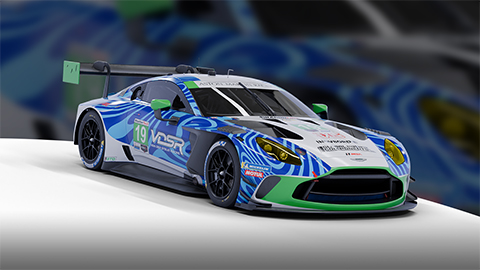
Image © iRacing.com Motorsport Simulations
Quick reference
- Chassis
- Short-long arm double wishbone front & rear, outboard coilover springs and dampers
- Power Unit
- Twin-turbocharged 4 L DOHC V8Twin-turbocharged 1.1 US gal DOHC V8
- Length
- 4,547 mm179 in
- Width
- 2,050 mm80.7 in
- Wheelbase
- 2,769 mm109 in
- Displacement
- 4 L244 cid
- Torque
- 640 Nm472 lb-ft
- RPM Limit
- 7000 RPM
- Power
- 399 kW535 bhp
- Dry Weight
- 1,330 kg2,932 lb
- Wet Weight with Driver
- 1,491 kg3,286 lb
The Vantage GT3 EVO combines a 4.0-litre twin-turbo V8 with adjustable ABS, traction control and four-way dampers. Its setup work centres on balancing the aerodynamic platform with mechanical grip, while brake pads and master-cylinder sizes let the driver tailor pedal response.
Braking characteristics
Brake-pad compound changes the trade-off between braking force and pedal modulation. Low provides less friction and more modulation; Medium and High increase friction but leave less modulation margin.
Each master-cylinder diameter also changes the response. A larger front master cylinder reduces front-caliper pressure, moves the effective balance rearward and requires more pedal effort to lock the front wheels; a smaller one does the opposite. A larger rear master cylinder reduces rear pressure and moves the balance forward; a smaller one increases rear pressure and moves the balance rearward.
Brake controls and adjustments
Brake Bias controls the percentage of braking force sent to the front brakes. Values above 50% increase front pressure, which may lead to front tire lock-up but can enhance stability. This setting should be adjusted to driver preference and track conditions. The ABS Setting offers twelve positions, with Position 1 having the least intervention and Position 11 the most. Position 0 disables ABS entirely. Position 3 is the recommended baseline. Settings 1-6 are for dry conditions, and 7-11 for wet conditions. Higher intervention reduces lock-ups but may increase braking distances.
Dashboard and driver controls
The single-page display groups fuel used since leaving the pits, fuel used on the last lap, speed, lap count and water/oil temperatures on the left. The centre shows gear, TC Slip, Red rotary, wiper, PAS and ABS. A/C is inoperative; Green is the non-adjustable wastegate setting fixed at 6; TC Pro is not an independent control and follows TC Slip. Last Lap, B Bias and the session-best delta appear on the right.
Pressure backgrounds are red when far below target, orange just below target and green at the optimum pressure. After a lap, purple areas briefly freeze the last-lap result. With the pit limiter active, the display shows a large speed readout: orange warns of excess speed, green indicates the limit and white indicates speed too low. The shift lights flash green; the side LEDs match the overspeed orange or at-limit green indication.
Tyres and operating conditions
The Aston Martin Vantage GT3 EVO supports Dry (slick) tires for dry conditions and Wet tires for rain. Cold Pressure, or starting pressure, influences grip (lower equals more grip, more drag, faster temperature build) and responsiveness (higher equals more responsive, less drag, less grip). Last Hot Pressure helps assess how tires are loaded; adjusting cold pressure based on hot pressure differences optimizes performance. Last Temperatures, measured within the tread, indicate tire work. Inner vs. outer temperatures guide wheel alignment, and center vs. outer temperatures help tune pressure. Tread Remaining indicates wear as a percentage of a new tire. Tread remaining helps estimate usable tyre life, but does not replace temperature readings when judging tyre workload.
Suspension and chassis
The front and rear ARB scales run in opposite directions: front 1 is stiffest and 8 softest; rear 1 is softest and 8 stiffest. A stiffer front bar adds understeer, while a stiffer rear bar adds oversteer. Softening both improves compliance over rough surfaces but reduces platform control and response. Front toe-out increases inside-tyre slip and reduces straight-line stability. Rear toe-in improves stability but slows direction changes and adds rolling drag when excessive; rear values apply to each wheel, unlike the combined front value.
Spring stiffness trades mechanical grip for control of ride-height variation; restore the intended garage ride height after changing springs. A smaller bump-rubber gap engages the additional stiffness sooner, helping prevent bottoming but compromising compliance on rough surfaces and in slow corners. Negative camber supports lateral grip at the expense of longitudinal grip; the rear also needs traction. X WT measures the right-front plus left-rear share of total weight: 50% is a starting point for symmetric road-course handling when the remaining setup is symmetric.
Four-way dampers separate low-speed compression/rebound, which respond mainly to driver-induced chassis movements, from high-speed compression/rebound for bumps and kerbs. These are damper-shaft speeds, not vehicle speeds. All four click scales use 0 for maximum damping and 18 for minimum. More front low-speed compression promotes understeer under braking; more rear low-speed rebound can stabilise braking, but too much adds understeer. More rebound resistance slows extension and may prevent the tyre following the road if excessive. Softer high-speed compression helps absorb rough surfaces at the expense of platform control; high-speed rebound controls the recovery after a bump. Avoid setting every adjuster at an extreme.
Aerodynamics
More rear wing adds downforce and drag and moves the aerodynamic balance rearward, increasing high-speed stability at the cost of straight-line speed. Ride heights and rake must be considered with it. The Aero Balance Calculator's front/rear ride-height inputs are references only: changing them does not move the chassis. Its wing-angle control does change the actual car and is linked to the Chassis tab. Use telemetry averages from both wheels of each axle as references, then apply the required ride-height change separately in the chassis setup.
The manual's maximum-downforce reference is +10.5° wing, 35 mm dynamic front height and 70 mm dynamic rear height, with ±2.5 mm height targets. Braking can lift the rear past that target, moving balance forward while losing downforce. The low-drag reference is +0.5° wing and 17.5 ±2.5 mm dynamic height at both ends; road contact can cancel the drag benefit. These are operating targets, not universal garage presets. The centre front splitter must be above 50 mm for inspection. Prefer the calculator to fixed wing/height conversion rules and prioritise balance across the whole lap.
Baseline is a stable high-downforce introduction; the manual recommends starting with High Downforce when no track-specific setup exists. Sprint setups carry 50% fuel for roughly 25–30-minute races, endurance setups 100% for around an hour or more, and wet setups include rain tyres. Nordschleife configurations have their own setups; do not substitute the ordinary baseline there.
Differential and transmission
The Aston Martin Vantage GT3 EVO offers two gear stacks: FIA, for most tracks, and LeMans, for high-speed tracks with low rear wing angles. Differential adjustments include Friction Faces, which multiply the overall force applied to lock the rear axle. More faces increase locking force, affecting off-throttle understeer and on-throttle oversteer, and reducing inside wheelspin on rough surfaces. Differential Preload is a static locking force. Increasing preload boosts off-throttle understeer and on-throttle oversteer, enhances corner entry stability, and smooths throttle transitions, reducing lift-off oversteer. Conversely, less preload increases lift-off oversteer.
The current iRacing transmission reference lists a six-speed semi-automatic sequential gearbox. Upshifts do not require lifting the throttle or using the clutch. Downshifts need neither clutch nor a manual throttle blip; the system waits for an appropriate engine speed. Use paddles or a sequential control rather than an H-pattern shifter. The clutch is needed to move off from a stop unless anti-stall clutch assistance is engaged.
Engine and electronic systems
The Aston Martin Vantage GT3 EVO is powered by a twin-turbocharged 4.0L DOHC V8 engine. Its electronic systems include Traction Control (TC), adjustable from Position 0 (disabled) to 11 (highest intervention). Positions 1-6 are for dry conditions, 7-11 for wet. More intervention reduces wheelspin and tire wear, but can hinder corner exit acceleration. The Red Rotary control manages turbocharger anti-lag system torque response, with Setting 1 causing the most turbo lag and Setting 5 providing the most aggressive anti-lag. Electronic Power Assisted Steering (EPAS) offers five settings, from Setting 1 (least assistance, heavier feel) to Setting 5 (most assistance, lightest feel).
Official sources
Stop Guessing, Start Improving
Many drivers slam the brakes with all their strength, but the fastest modulate pressure, use the brake to rotate the car, and exit as fast as possible. Train that skill here.
Train Anywhere, Anytime
Browser-based training works with any racing pedals or controllers. Fanatec, Thrustmaster, Logitech, Simucube — no installation required.
Pro-Designed Exercises
Access exercises created by professional sim racers like Suellio Almeida. Learn the exact braking patterns used by the fastest drivers.
Import Aston Martin Vantage GT3 EVO Telemetry
Drop your Garage61 lap CSV and extract braking data for every corner. Generate personalized practice exercises based on YOUR telemetry, not generic patterns.
Track Your Progress
View session history, performance trends, and best scores. Watch yourself improve over time and stay motivated to practice.
And There's Much More
Improve your braking technique with this car and much more:
Create Custom Exercises
Build from templates, draw brake curves, or record with your pedal
Schedule Your Training
Plan practice sessions and track your consistency across weeks
Brake Master Ratings
Earn rankings and compete on leaderboards as you improve
Exercises & Progress Tracking
Practice exercises and track your progress completely free.
No install needed • Works in browser
General practice tips
Tip 1
Starting point
Start with the official setup and consult the simulator documentation for available controls. Appropriate brake bias depends on the car and conditions.
Tip 2
One variable
Change one setting at a time and compare several laps. Record the change and observed behavior before keeping it.
Tip 3
Comparable conditions
Compare similar fuel loads, tires and track conditions. One lap alone does not establish that a setting is better.
Frequently asked questions
General guidance for practicing and consulting car-specific sources.