BMW M Hybrid V8 Evo
Explore source-backed information about BMW M Hybrid V8 Evo in iRacing.
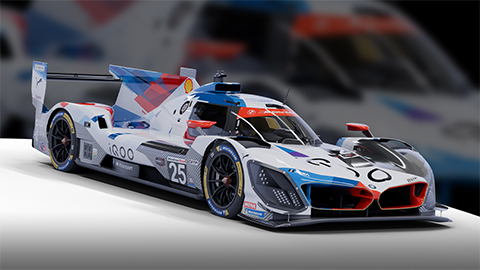
Image © iRacing.com Motorsport Simulations
Quick reference
- Displacement
- 4 L244 cid
- Powertrain
- Combustion engine and electric motor
- Published combustion-engine power
- Approximately 477 kWApproximately 640 hp
- Transmission
- Seven-speed semi-automatic sequential
BMW's M Hybrid V8 Evo is the 2026 evolution of its modern endurance prototype. It combines a four-litre combustion engine with an electric motor and brings revised aerodynamics and headlights to the existing iRacing car.
Aerodynamics
The Evo revision brings aerodynamic changes and redesigned headlights intended to improve night visibility. In iRacing, the June 2026 update replaced the previous model automatically for existing owners and updated the paint templates.
Differential and transmission
The current iRacing transmission reference places this car in the semi-automatic sequential group. Upshifts need neither a throttle lift nor the clutch. Downshifts need no manual blip or clutch input; the system waits for suitable engine speed. Use paddles or a sequential control, not an H-pattern shifter. Moving away from a stop requires the clutch unless anti-stall clutch assistance is active.
Engine and electronic systems
The official Evo description quotes approximately 640 hp from the combustion engine alone, with an electric motor also contributing. That figure is not a combined hybrid-output specification. The model continues BMW's prototype programme that entered IMSA competition in 2023.
Official sources
Stop Guessing, Start Improving
Many drivers slam the brakes with all their strength, but the fastest modulate pressure, use the brake to rotate the car, and exit as fast as possible. Train that skill here.
Train Anywhere, Anytime
Browser-based training works with any racing pedals or controllers. Fanatec, Thrustmaster, Logitech, Simucube — no installation required.
Pro-Designed Exercises
Access exercises created by professional sim racers like Suellio Almeida. Learn the exact braking patterns used by the fastest drivers.
Import BMW M Hybrid V8 Evo Telemetry
Drop your Garage61 lap CSV and extract braking data for every corner. Generate personalized practice exercises based on YOUR telemetry, not generic patterns.
Track Your Progress
View session history, performance trends, and best scores. Watch yourself improve over time and stay motivated to practice.
And There's Much More
Improve your braking technique with this car and much more:
Create Custom Exercises
Build from templates, draw brake curves, or record with your pedal
Schedule Your Training
Plan practice sessions and track your consistency across weeks
Brake Master Ratings
Earn rankings and compete on leaderboards as you improve
Exercises & Progress Tracking
Practice exercises and track your progress completely free.
No install needed • Works in browser
General practice tips
Tip 1
Starting point
Start with the official setup and consult the simulator documentation for available controls. Appropriate brake bias depends on the car and conditions.
Tip 2
One variable
Change one setting at a time and compare several laps. Record the change and observed behavior before keeping it.
Tip 3
Comparable conditions
Compare similar fuel loads, tires and track conditions. One lap alone does not establish that a setting is better.
Frequently asked questions
General guidance for practicing and consulting car-specific sources.
Where can I find current information about the BMW M Hybrid V8 Evo?
Where can I find current information about the BMW M Hybrid V8 Evo?
Explore MoreOther Cars
Similar cars you might be interested in learning
Ready to Master the BMW M Hybrid V8 Evo?
Put this knowledge into practice with Braking Lab's interactive brake training exercises. Import your telemetry and get personalized feedback.